
Electronic logging device
An ELD that keeps the log for you.
FWING ELD is three things that work as one: a plug that reads your truck, an app that keeps your hours, and a portal where your office sees the same numbers you see. You drive. The log takes care of itself.
What it is
Three parts. One log.
The plug
A small device plugs into your truck's diagnostic port. It reads the engine directly: engine on or off, the truck moving or standing, miles driven, and engine hours. No guessing, no typing numbers in.
The app
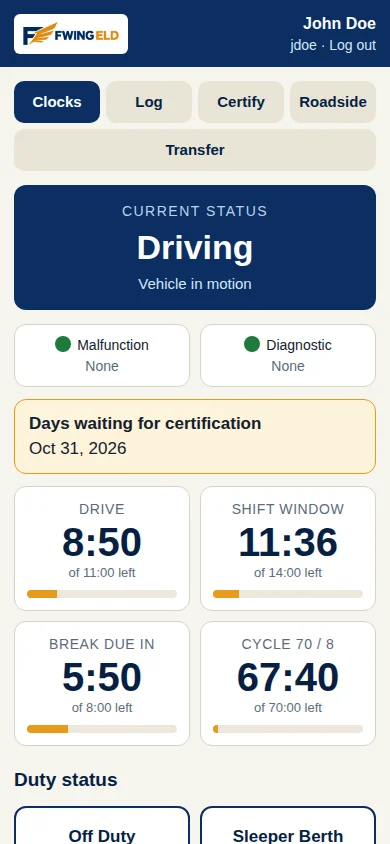
The FWING ELD app runs on the phone or tablet you already carry, on Android and on iPhone. It keeps your duty status, shows your hours counting down, and records everything even with no signal at all.
The portal
Your office opens the fleet portal and sees every truck and every driver, with the same hours the driver sees in the cab. Nothing has to be phoned in, photographed, or re-typed.
Your hours
Four clocks. Always in front of you.
The app counts the four clocks the federal hours-of-service rules run on, and shows them big enough to read at a glance.
Drive
How much driving time you have left today, out of your 11 hours.
Shift window
How much time is left in your 14-hour work window before you must stop.
Break
How soon your 30-minute break is due, counted from your driving time.
Week
How much time is left in your 60- or 70-hour week, and when hours come back.
When you split your rest in the sleeper berth, the app does that math too — and says plainly when a rest period only counts once its matching half is done.
Your records
A record that can't be quietly rewritten.
A log only protects you if nobody can change it behind your back. FWING ELD is built so they can't.
The original always stays
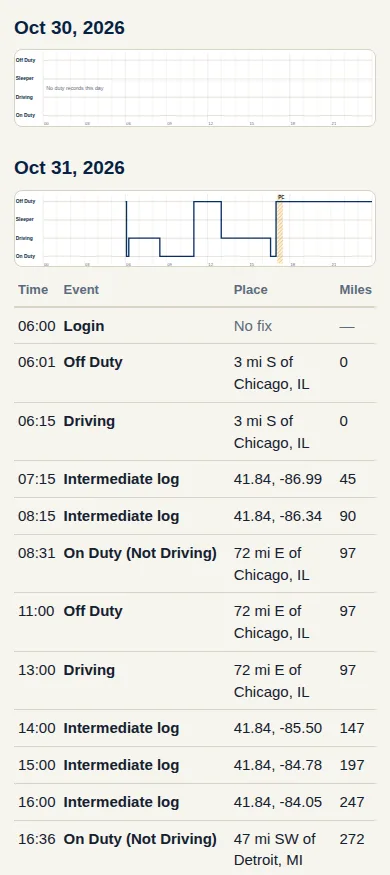
When a record is corrected, the first version is kept and marked as changed. The fix stands next to it. Nothing is ever erased or silently replaced.
The office asks. You decide.
If your office spots a mistake, they can suggest a fix in the portal. It only takes effect when you, the driver, approve it in the app. Driving time can never be shortened by an edit.
Every record carries a check
Each record is sealed with a check value worked out from its own contents. If a single character is different later, the record no longer checks out — and the system says so.
At the roadside
Stopped for an inspection? One tap sends your records.
The roadside screen shows the officer your current day and the seven days before it, right on your device. When the officer wants the file itself, one tap sends it by web services or by email — the telematics ways the federal rules provide for.
Who it's for
Built for the way small trucking really runs.
Owner-operators
You are the driver and the office. FWING ELD keeps the log while you drive, and the portal is there when you sit down to run the business.
Small fleets
Every truck and driver in one place, with hours the office and the cab agree on — because both sides read the same records.
Team drivers
Two drivers, one truck. Both of you stay signed in. The one at the wheel owns the driving; the other rests on his own clocks, untouched. You swap at a stop, and each of you signs only your own day.
Guides
The rules, in plain words.
The hours rules and the ELD rules are written in legal language. Our guides translate them: what the rule says, how the math works on a real day, and where drivers get tripped up. Free to read, whether you run FWING ELD or not.
Hours of service, explained plain
The 11-hour drive limit, the 14-hour window, the 30-minute break and the 60/70-hour week — how the four clocks fit together on one real day.
Split sleeper berth
The pairing rule — one rest of at least 7 hours in the berth, one of at least 2 — with the math worked through hour by hour.
Roadside inspection
How the record transfer works, what the officer sees, and the small packet of papers the rules say must be in the truck.
When the ELD breaks
The malfunction drill: note it, tell the carrier within 24 hours, run on paper, and mind the carrier's 8-day repair clock.
Built to the federal book
Built and tested to the FMCSA specification.
FWING ELD is built to the federal ELD specification — 49 CFR Part 395, Subpart B, Appendix A — and tested against FMCSA's own published test procedures. One honest note: FMCSA does not approve logging devices in advance, for anyone. Providers build to the specification, test, certify their device, and register it. That registration is the step FWING ELD completes before the first customer truck rolls.
Questions about your trucks?
Every fleet is a different size and a different story. Call us, tell us how you run, and we'll talk it through with you — or write, if you'd rather.